Cartoning & case handling
Use rods, pushers or carrier fixtures to keep packs registered through transfers, closing and discharge sections.
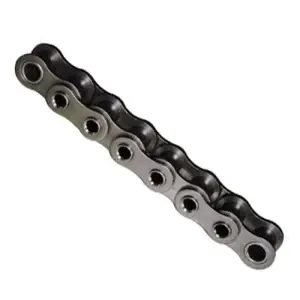
Hollow pin chains for packaging conveyors that use carriers, pushers, rods and fixtures to control cartons, trays, pouches, bottles or components.
Use rods, pushers or carrier fixtures to keep packs registered through transfers, closing and discharge sections.
Compact attachment spacing can support repeatable product positioning and controlled movement between stations.
Hollow-pin attachments can carry guides, stops or fixtures where products must remain aligned through sensors and inspection stations.
Cross rods and customized carriers can connect chain motion to collating, grouping, transfer and light pallet-handling functions.
Short-pitch hollow pin chain is a good starting point for compact packaging machines. MC, FVC and ZC series can suit larger conveyor envelopes or different roller arrangements. Stainless hollow pin chain can be considered where moisture, washdown or corrosion resistance is important.
Provide pitch or existing model, hollow-pin bore, inner width, roller style, number of strands, carrier or cross-rod drawing, sprocket details, conveyor speed, product load, indexing or start-stop pattern and annual quantity.
Describe dust, moisture, cleaning, lubricant restrictions and temperature. Packaging lines that handle food or pharmaceutical products may also need material or lubricant requirements from the machine specification.
If you are replacing an existing chain, include the machine make/model when available, photos of the chain on the sprocket and guide, several measured pitches, hollow bore, inner width, roller or bush diameter, overall pin projection and attachment dimensions. This makes it much easier to compare the existing conveyor with a suitable hollow pin chain model.
Send your drawing, dimensions and operating conditions. We can help you compare a suitable series and model for the conveyor.
Cross rods, pushers or carriers can keep cartons, trays, bottles or components separated as they enter a process. Confirm that the attachment does not interfere with guide rails or side belts through the full machine cycle.
When each pitch or selected pitches carry a fixture, the chain becomes part of the machine timing system. Sprocket engagement, tension and matched strands matter to station-to-station repeatability.
A hollow bore can support quick-change rods or brackets when the retention method is accessible and secure. Share the smallest and largest format so the carrier system can be reviewed across the full range.
Light pushers or support bars can be mounted at controlled intervals. Product impact at transfer points should be considered because it can create shock loads beyond the steady conveyor load.
Start with pitch, hollow bore and inner width, then add roller or bush diameter, plate height, pin projection and finished chain length. If two strands carry one rod, include the chain-centre distance, rod diameter, unsupported span and product load. If the machine uses multiple carrier spacings, show which pitches are equipped with attachments and how the unused positions are handled.
| Packaging requirement | Chain question | Design check |
|---|---|---|
| Compact machine | Can a shorter pitch reduce sprocket diameter? | Confirm bore, roller and plate envelope still fit the attachment. |
| Frequent format change | Can the carrier be removed through the hollow pin? | Specify rod retention, tool access and repeat location. |
| Two-strand carrier | Do the strands need matched length? | Check cross-rod stiffness and alignment across conveyor width. |
| High cycle rate | How often does the line start and index? | Review sprocket engagement, lubrication and shock duty. |
Rotate the conveyor slowly and confirm that every rod, carrier and fastener clears guards, rails and sprockets. Check that chain tension is even on parallel strands and that the carrier remains square through the full path. Run several empty cycles before introducing product, then inspect for side rubbing, abnormal noise or a carrier that shifts under acceleration.
After the first production period, inspect the attachment hardware again. A loosening rod or misaligned guide can damage the hollow pin even when the basic chain load is modest. Recording the final chain model, pitch count, carrier drawing and sprocket details in the machine BOM makes future replacement much faster.
A sample is useful when the installed chain has a non-standard plate shape, unusual roller arrangement or attachment detail that is difficult to capture from an old parts manual. Send the cleanest available section and identify which dimensions are critical to the machine. A sample should complement—not replace—a dimensional check, because wear can change pitch, bore and roller size.
For new packaging equipment, a controlled drawing is preferable because it separates required dimensions from prototype wear or fabrication tolerance. If the machine will be duplicated later, keep the approved chain and carrier drawings in the BOM so repeat builds use the same interface.
Request a Quote
Send the chain model or dimensions, attachment drawing, sprocket information, operating speed and load, environment and quantity. We will help you identify a suitable hollow pin chain configuration.