Sorting & transfer conveyors
Use pushers, rods or carriers to guide products between conveyor sections.
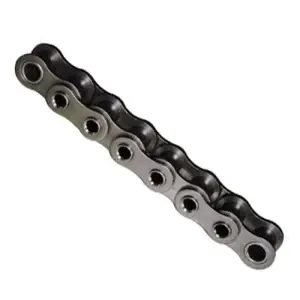
Hollow pin chains for light material handling, intralogistics and conveyor systems using pushers, rods, guides and customized product supports.
Use pushers, rods or carriers to guide products between conveyor sections.
Support totes, trays, containers or components with custom attachments on a repeatable chain pitch.
Combine suitable roller/guide layouts with attachments designed for the product and accumulation method.
Adapt the hollow pin to bars, spacers and machine-specific carrier elements.
MC, FVC and ZC series are useful starting points for general material-handling conveyor layouts. Short-pitch chains can support compact equipment and close spacing, while stainless models can be considered for humid or corrosion-sensitive areas.
Provide product dimensions and weight, conveyor width, chain center distance, speed, starts/stops, accumulation method, attachment drawing, pitch or sprocket details, roller/guide arrangement and total chain length.
Dust, moisture, abrasive debris, temperature and lubrication access can change the preferred construction. Include these conditions in the inquiry so the chain and maintenance approach can be selected together.
If you are replacing an existing chain, include the machine make/model when available, photos of the chain on the sprocket and guide, several measured pitches, hollow bore, inner width, roller or bush diameter, overall pin projection and attachment dimensions. This makes it much easier to compare the existing conveyor with a suitable hollow pin chain model.
Send your drawing, dimensions and operating conditions. We can help you compare a suitable series and model for the conveyor.
Intralogistics conveyors can use cross rods, pushers, guides or product supports to move totes, cartons and components between processes. A hollow-pin chain is useful when these elements need to be removable or positioned at regular pitch intervals. The attachment concept should still respect the chain path, guide rail and transfer geometry.
Light pushers can be mounted at defined positions, but impact from a divert action should be separated from normal conveyor pull when estimating duty.
Cross rods between two chains can support products or secondary elements. Rod stiffness and strand alignment become critical as conveyor width increases.
Accumulation or zone control can increase cycle count. State start frequency, line speed and whether product contact creates intermittent shock.
Distribution sites value quick replacement. Keep chain model, length, attachment spacing and sprocket information in the spare-parts record.
When two hollow-pin chains are connected by long bars, the bar can bend under product load or during a jam. Provide chain-centre distance, rod diameter, rod material and the load carried between strands. If a product can snag or shift sideways, include that side-loading scenario as well. The hollow pin should not be treated as a universal hinge for any span or rod size.
Material-handling equipment often stays in service for many years, so a replacement chain may be installed on worn guides or sprockets. Photograph the tooth profile and guide contact surface before ordering. A new chain on hooked sprocket teeth can run roughly and wear quickly; a guide that has developed a shoulder can force the new chain sideways.
| Project | Information to provide | Key check |
|---|---|---|
| Carton pusher | Pusher spacing, product weight, speed | Impact and clearance |
| Cross-rod conveyor | Strand spacing, rod drawing, total load | Rod deflection and matched chains |
| Legacy replacement | Old chain, sprocket and guide measurements | Dimensional interchange |
| High-cycle zone | Starts/stops per hour and line speed | Dynamic duty and lubrication |
Sorting and logistics conveyors can see unusual forces during a blocked transfer, skewed carton or failed sensor. Describe whether the attachment can strike a product or stop while the chain continues to pull. A mechanical overload path, slip device or controlled stop may be more appropriate than asking the chain attachment to survive every jam without movement.
After a jam, inspect cross rods, hollow bores and guide alignment before restarting at full speed. A bent rod can continue to run while quietly forcing two strands out of alignment and creating accelerated wear.
For long warehouse or factory conveyors, divide the system into serviceable sections where practical and identify which chain length belongs to each zone. If several identical conveyors are installed, standardizing the chain, sprocket and attachment drawing can reduce spare-part variety. Mark any exception clearly so maintenance teams do not install a visually similar chain in the wrong machine.
Where conveyors run close to personnel or automated picking equipment, attachment projections should remain within the guarded envelope throughout the return path as well as the carrying path. Include the return-side guide arrangement in the drawing review.
Request a Quote
Send the chain model or dimensions, attachment drawing, sprocket information, operating speed and load, environment and quantity. We will help you identify a suitable hollow pin chain configuration.