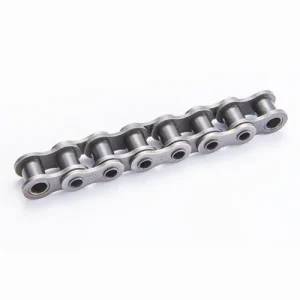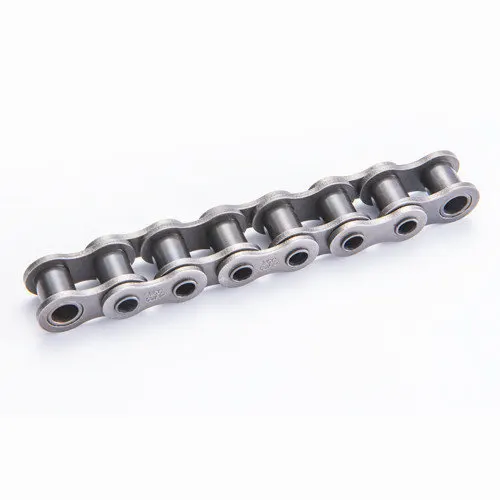
Description
ZC150 is an alternative hollow pin conveyor chain geometry for customized conveyor and carrier designs. It is designed for conveyors that use the hollow pin as a mounting point for cross rods, product carriers, spacers, guides, pushers or customized fixtures.
ZC150 specifications
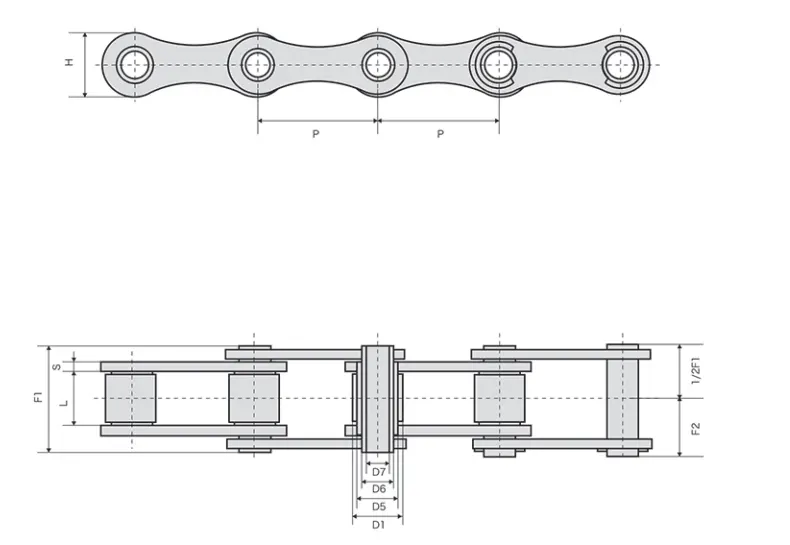
| Pitch options P (mm) | 101.6 / 127 / 152.4 / 177.8 / 203.2 / 228.6 / 254 |
|---|---|
| Roller diameter d1 max (mm) | 66.7 |
| Width between inner plates b1 min (mm) | 26.0 |
| Pin diameter d2 max (mm) | 26.9 |
| Hollow bore d3 min (mm) | 20.2 |
| Pin length L / Lc max (mm) | 58.0 / 60.5 |
| Plate thickness T max (mm) | 7.0 / 5.0 |
| Plate depth h2 max (mm) | 50.0 |
| Minimum tensile strength Q | 150.0 kN |
| Heat-treated tensile reference Q* | 190.0 kN |
Best suited to
ZC150 can be considered for special-purpose conveyors, handling equipment, pushers and custom product-support systems. ZC series can be compared when its chain width, roller arrangement and hollow-pin geometry suit the existing machine or new layout. The final choice should also match the sprocket, guide rail, attachment layout, conveyor speed, product load and environment.
Attachment possibilities
The through-bore can be used with rods, bolts, spacers and custom carrier hardware. When an attachment connects two parallel chains, provide the chain center distance, cross-member diameter, span and load position. For single-strand attachments, show the side clearance and retaining method so the hardware can pass through guides and around the sprocket without interference.
Cross rods
Connect two strands for slats, carriers and product supports.
Pushers & fixtures
Create repeatable attachment points for indexing and product positioning.
Removable hardware
Use bolts, collars, spacers or other serviceable retaining concepts around the hollow bore.
How to choose ZC150
- Confirm the pitch and sprocket tooth geometry.
- Compare hollow bore with the proposed rod or attachment diameter.
- Check inner width, roller/bush diameter and plate envelope against the guides.
- Check overall pin projection against side-frame and transfer clearances.
- State conveyor speed, operating load, starts/stops and any shock or jam conditions.
- State moisture, washdown, dust, temperature and lubrication requirements.
Replacement matching
If ZC150 is being considered as a replacement, measure several pitches under light tension and record the hollow bore, inner width, roller or bush diameter and overall pin length. Add the sprocket tooth count and clear photos of the chain in the guide and around the drive sprocket. These checks help avoid a dimensional match that still conflicts with the existing machine.
Maintenance
Keep sprockets aligned and inspect tooth wear when replacing chain. Monitor chain elongation over a fixed number of pitches, look for stiff joints, check hollow bores and inserted rods for fretting or looseness, and inspect guides for uneven contact. Where lubrication is permitted, apply a suitable lubricant to the articulating joint rather than only the outside plates.
Request a ZC150 quote
Send the required chain length or pitch count, number of strands, attachment drawing, sprocket details, conveyor speed, load, environment, material requirement and quantity to [email protected]. If you are replacing an existing chain, include photos and measured dimensions.
Specification note: Dimensions shown are for product selection. The quoted chain configuration should be checked against your machine dimensions and order requirements before manufacture.
How to evaluate ZC150 in your conveyor
ZC150 should be selected as part of the complete conveyor interface, not from the model number alone. The listed pitch options are 101.6 / 127 / 152.4 / 177.8 / 203.2 / 228.6 / 254 mm, with a minimum hollow bore of 20.2 mm and an inner width of 26.0 mm. Use these dimensions to compare the chain with the sprocket, guide rail and attachment drawing. If the chain is replacing an installed part, measure several pitches under light tension and compare the worn sample with the machine documentation before approving an interchange.
ZC150 within the ZC Series
ZC hollow-pin chains give machine builders another geometry for carrier and rod conveyors. For ZC150, review the listed pitch range together with the bore, inner width and roller arrangement. If the machine was originally designed around ZC geometry, preserving sprocket engagement and guide height is normally more important than moving to a visually similar family. Send the sprocket and guide dimensions when the original chain code is uncertain.
Attachment and cross-rod checks
The hollow pin provides a mounting path for rods, spacers, product carriers or custom fixtures, but the attachment becomes part of the load path. State rod diameter, rod material, retention method and the distance between chain strands. For a wide two-strand conveyor, include the unsupported rod span and product or fixture load so bending and side load can be reviewed. If the attachment is removed during product changeover or sanitation, show the outside retention hardware and confirm tool access around the chain.
Sprocket, guide and maintenance compatibility
Pitch is only one part of interchange. Confirm roller or bush diameter, inner width, side-plate envelope and overall pin projection against the existing sprocket and guide. A new chain should not be installed on badly hooked sprocket teeth or a guide rail that forces the chain sideways. After installation, run the conveyor slowly without product, watch the chain through the sprockets and guides, then recheck tension and attachment hardware after the first operating period.
Chain construction reference
What to include in an RFQ
- Model or original chain marking
- Required pitch option and finished length
- Hollow bore and attachment drawing
- Sprocket tooth count and guide dimensions
- Single or matched parallel strands
- Speed, load and start-stop duty
- Temperature, moisture, dust or washdown
- Quantity and delivery destination