Germany Hollow Pin Chain Guide
DE
Germany market
Hollow Pin Chain for German Packaging & Food Machinery
Germany combines a large machinery-manufacturing base with globally competitive food-processing and packaging equipment. For hollow pin chain buyers, that translates into projects where metric geometry, precise attachment interfaces, hygienic operating conditions and repeatable documentation often matter as much as basic chain size.
Packaging OEMsFood machineryMetric drawingsExport equipment
Industry scale€16.1B
VDMA reported 2024 production for German food-processing and packaging machinery.
Export strength€10.6B
Exports rose 6% in the same sector, reinforcing Germany’s export-oriented machine-building role.
Supplier base320+ companies
VDMA’s food-processing and packaging machinery association represents more than 320 mainly medium-sized manufacturers.
Design themesHygienic + digital
VDMA industry topics include hygienic design, food-contact materials, machine safety, digitalization and sustainable processing.
Where hollow pin chain fits in German machinery
01
Packaging machines
Cartoners, tray handling, pouch and case conveyors can use hollow pins for cross rods, removable carriers, pushers and product-specific fixtures. Short-pitch chains are useful where the machine envelope is tight and carrier spacing is close.
02
Food processing
Beverage, dairy, bakery, confectionery and protein-processing equipment often combines product handling with wet cleaning or food-zone restrictions. Stainless hollow pin options may be appropriate where corrosion resistance and cleanability are part of the machine specification.
03
Special-purpose automation
German machine builders frequently deliver custom automation rather than one universal conveyor. Hollow pins allow fixture geometry to be changed without redesigning every chain link, which is useful for indexed carriers and parallel-strand assemblies.
What German OEM and maintenance teams usually need to confirm
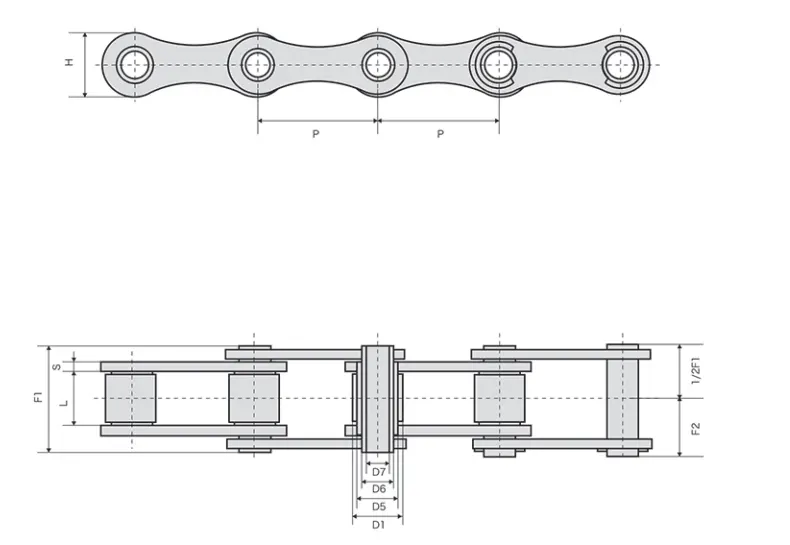
Start with a dimensioned drawing in millimetres. Record pitch over several links, minimum hollow bore, inner width, roller or bush diameter, plate height and thickness, overall pin projection and chain centre distance when two strands are linked by cross rods. On replacement jobs, include sprocket tooth count and photos of the chain entering and leaving the sprocket so the wear pattern can be interpreted alongside the dimensions.
For a new machine
- Target pitch and required carrier spacing
- Cross-rod, slat or fixture drawing with tolerances
- Product plus carrier mass and load position
- Speed, indexing frequency and start-stop duty
- Guide material and sprocket arrangement
- Washdown, chemicals, temperature and lubrication limits
For a replacement
- Existing model or side-plate marking
- Measured chain length across several pitches
- Hollow bore, inner width and roller/bush size
- Pin projection and retaining hardware
- Sprocket tooth count and bore/hub constraints
- Required documentation and annual quantity
Machine-building priorities that influence chain choice
German packaging and food-machinery suppliers compete internationally, so a chain may be selected once and then used on machines shipped to many countries. That makes stable model control and repeatable replacement dimensions important. If the chain is part of a hygienic or washdown zone, specify the required material rather than asking only for “stainless.” Cleaning chemistry, temperature and lubrication rules can change the practical requirement. For a dry packaging cell, by contrast, compact pitch, low maintenance and fast attachment changes may dominate.
Where two strands carry a wide fixture, ask whether matched lengths are required. A rigid cross member can amplify small differences in chain elongation and create side load in the guides. On indexed equipment, also confirm whether the carrier position is driven directly by chain pitch or corrected elsewhere in the machine. These details help decide whether a short-pitch family, MC geometry or a larger conveyor family is the better starting point.
Recommended starting families for German projects
| Requirement |
Good starting family |
What to confirm |
| Compact cartoning / indexing |
Short-Pitch |
Metric pitch, carrier interval, small sprocket clearance and speed |
| General machine conveyor |
MC Series |
Bore, inner width, roller style, guide rail and attachment span |
| Wide cross-rod conveyor |
FVC Series |
Chain-centre distance, rod bending, load and matched strands |
| Custom carrier geometry |
ZC Series |
Envelope, roller arrangement, guide support and sprocket fit |
| Wet / washdown zone |
Stainless Steel |
Requested grade, cleaning chemistry, lubrication and load |
Useful RFQ language for a German buyer
A concise inquiry can state the machine type, existing chain model, required length, number of strands, pitch, hollow-bore diameter, attachment drawing, sprocket tooth count and destination. For engineered assemblies, add drawing revision, tolerance-critical dimensions, material requirements, inspection or certificate needs and whether the chain must be supplied as matched pairs. This gives purchasing a quote that can be compared technically instead of only by price.
What German OEM procurement usually needs from a chain supplier
Germany’s food-processing and packaging machinery industry is strongly export oriented, so a component selected for one machine can ultimately operate in many countries. For chain purchasing, that makes repeatability important. A useful RFQ should identify the machine series, chain drawing or model, sprocket tooth count, required chain length and attachment arrangement. If the machine is built in repeated batches, include the expected annual quantity and whether the chain must remain interchangeable across future builds.
Metric documentation should be unambiguous. State pitch, hollow bore, inner width, roller diameter, plate height, plate thickness and overall pin length in millimetres, and mark any dimension that is a measured service value rather than a nominal drawing value. When two parallel strands carry cross rods, specify chain centre distance and whether matched-length supply is required. This reduces the risk of a carrier system pulling out of square during indexing.
Food machinery: design around cleaning and service access
VDMA’s food and packaging machinery community places continuing emphasis on hygienic design, food-contact topics, machine safety and efficient production. A hollow pin chain used near an open product zone should therefore be discussed with the complete conveyor environment in mind. Tell us whether the chain sees splash, foam cleaning, humidity, dry product dust or direct washdown; whether lubrication is restricted; and whether removable rods or carriers have to be taken out for sanitation.
Stainless chain can be an appropriate starting point for wet or corrosive zones, but material alone does not solve a poor conveyor layout. Drainage, guide wear, sprocket alignment, trapped product and attachment hardware also affect service life. For dry secondary packaging, a standard conveyor family may be the better fit if the load, speed and maintenance practice support it.
Replacement chain for German-built equipment
If the original part number is unavailable, work from the machine interfaces. Compare several pitches, the hollow-pin bore, side-plate envelope and roller position with the sprocket and guide. Do not approve a replacement only because the nominal pitch matches. Differences in bore or pin projection can interfere with rods; a different roller diameter can change guide contact; and a small inner-width difference can make a sprocket bind.
For machine builders
- Machine series and BOM reference
- Metric chain and sprocket drawing
- Carrier or cross-rod detail
- Matched-strand requirement
- Annual build quantity
For maintenance teams
- Machine maker and model
- Old chain marking if readable
- Several-pitch measurement
- Sprocket and guide photos
- Operating and cleaning conditions
RFQ
Send your chain drawing or model
Include the chain model or measured dimensions, attachment or cross-rod drawing, sprocket information, operating speed and load, environment, quantity and delivery destination. We can review a new-machine requirement or a replacement chain.