Chain selection guide
Compare pitch, bore, width, roller arrangement, load and environment to narrow the product family.
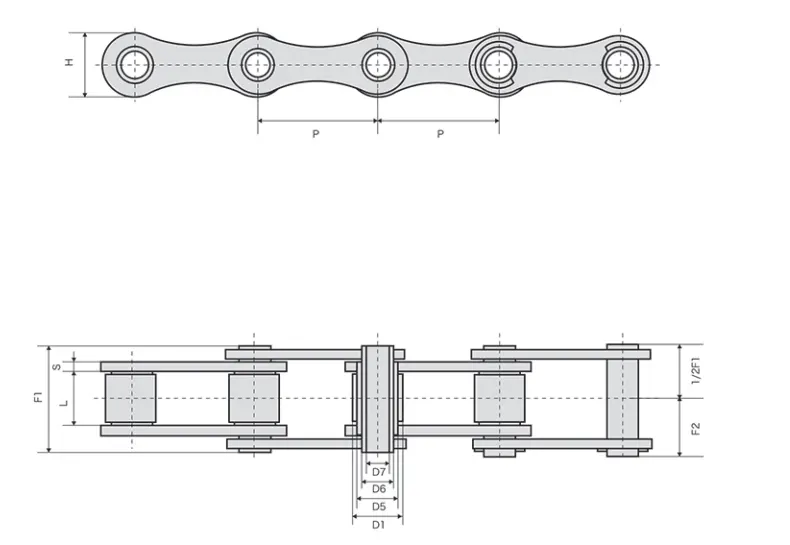
Use these technical guides to compare hollow pin chain dimensions, attachment ideas, sprocket fit and maintenance requirements before you request a quote or replace an existing chain.
Compare pitch, bore, width, roller arrangement, load and environment to narrow the product family.
Plan rods, spacers, fixtures and cross members around the hollow bore and available pin projection.
Check alignment, guide contact, lubrication, elongation and sprocket wear before a replacement is installed.
Choose stainless chain by cleaning conditions, corrosion exposure, load and lubrication requirements.
| Dimension | Buyer use |
|---|---|
| Pitch | Matches the sprocket and determines repeating attachment spacing. |
| Hollow bore | Sets the nominal space for the inserted rod, bolt or attachment element. |
| Inner width | Must fit the sprocket, guide and machine envelope. |
| Roller / bush diameter | Controls contact with the support rail and sprocket geometry. |
| Plate height / thickness | Affects chain envelope, clearance and construction. |
| Pin length | Determines available side clearance and attachment space. |
Measure several pitches under light tension, not just one worn joint. Record the hollow bore, inner width, roller or bush diameter and overall pin projection. Check the sprocket teeth for hooking or uneven wear and photograph guide contact. If the conveyor has two strands joined by cross rods, measure chain center distance and inspect whether the rods remain square.
Define product load, carrier spacing, conveyor speed, starts and stops, number of strands, attachment span, guide arrangement, environment and maintenance access. Then select a chain family and model that fits the machine envelope. For customized attachments, include a dimensioned sketch showing where the load acts on the carrier.
Send your dimensions or conveyor drawing and the operating conditions. We can help you compare models before quotation.
Start with pitch, hollow bore, inner width, roller arrangement and chain envelope. These dimensions determine whether the chain can fit the sprocket, guide and attachment.
Add cross-rod diameter, carrier position, retention method, strand spacing and unsupported span. The attachment is part of the load path.
Speed, starts/stops, load, alignment, contamination and lubrication influence wear and the suitable chain family.
Store the final chain model, length, sprocket data and drawing revision so future maintenance does not need to reverse-engineer the conveyor.
A clear conveyor drawing lets us compare chain pitch, sprocket, guide and attachment in one view. For replacements, add the old chain dimensions and photos. For new designs, add the planned rod or carrier, chain-centre distance, speed, load and environment. The more complete the machine interface, the less likely a dimensionally similar but unsuitable chain will reach the quotation stage.
Request a Quote
Send the chain model or dimensions, attachment drawing, sprocket information, operating speed and load, environment and quantity. We will help you identify a suitable hollow pin chain configuration.